Prompt Improvement Is Change Control
When a Prompt Is Part of the Product
A team is about to move an AI feature to a new model. The prompt behind the application already does real work: it defines the output shape, gives examples, encodes rules, names forbidden behavior, and tells the model how to handle edge cases.
The tempting version of the decision sounds simple: upgrade the model, adjust the prompt if the answers look worse, and ship when the demo feels better. That treats the prompt as wording. In many AI applications, the prompt is closer to an executable control surface. It changes what the application does.
Before promoting the change, the team needs release questions, not copy-editing questions: what changed, what evidence shows the change worked, and who owns the decision?
That is the governing mistake: treating prompt improvement like phrasing work when it is often change control for prompt-dependent behavior.
This does not mean every prompt tweak needs ceremony. It means the release review should match the risk. Once prompts encode business rules, operational constraints, output contracts, or domain judgment, “better wording” is not enough.
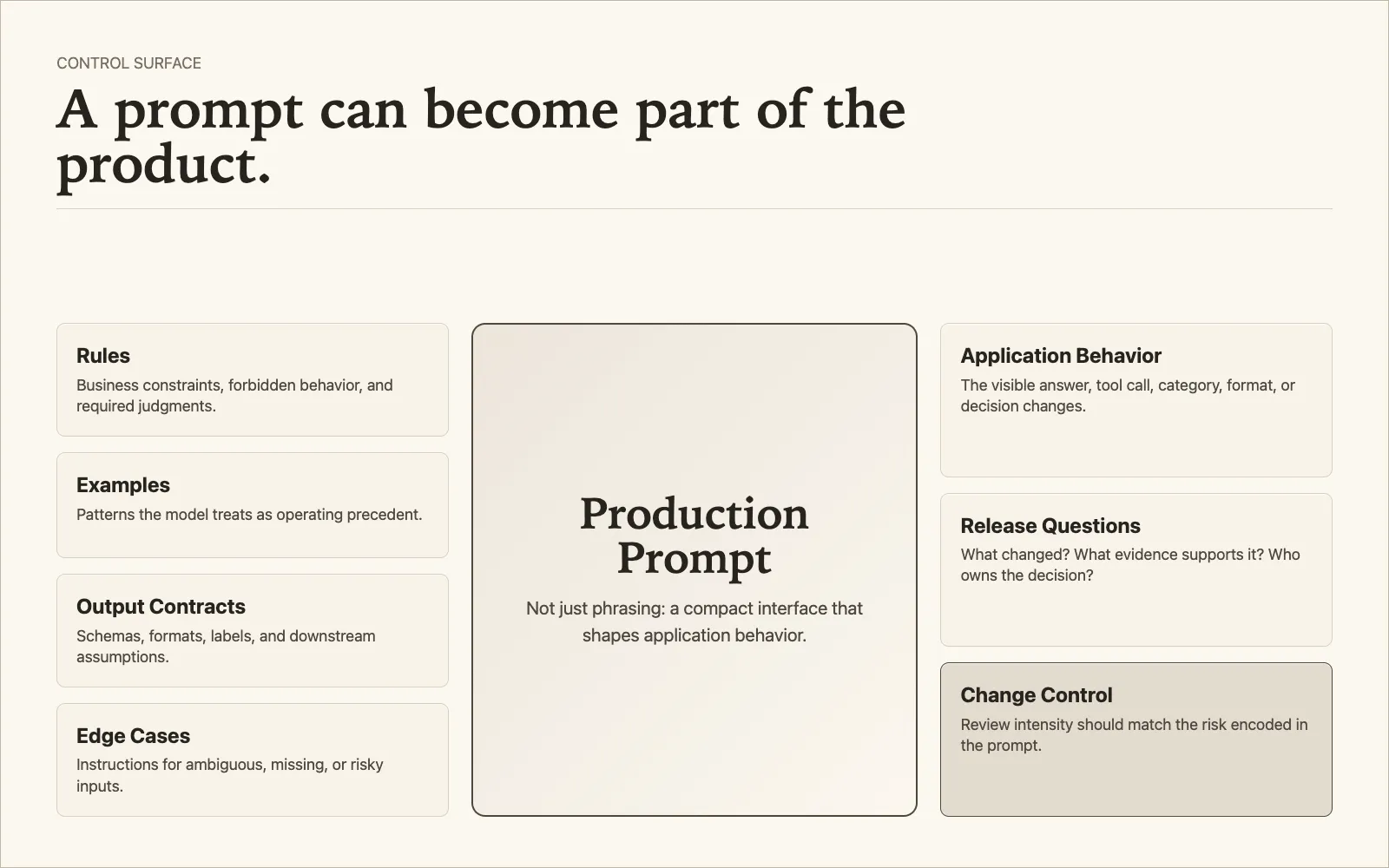
Once a prompt encodes rules, schemas, and domain judgment, editing it becomes a release decision, not just wording work.
The False Comfort of Better Words
One bet says prompt quality is mostly a writing problem: make the instruction clearer, add examples, and move on. That works for prototypes and some low-risk internal workflows. It breaks down when the prompt has become a compact operating manual for an application.
Another bet says better models will absorb the work. A stronger model may follow instructions better, reason more capably, and handle ambiguity with less brittle prompting. But a new model can also shift edge-case behavior, change formatting habits, handle tool calls differently, or interpret examples in a new way.
Neither bet is irrational. Better writers and better models matter. The problem is expecting them to carry reliability work that belongs around the prompt. If the only evidence for a change is that a few outputs look better, the team has changed the application and hoped the change lands in the right direction.
The Smallest Useful Loop
A useful loop has five jobs.
- Baseline the existing prompt against examples that represent the work it is supposed to do.
- Separate failures by type, because a single score can rank candidates but cannot explain how to repair them.
- Propose a bounded change that addresses a named failure without rewriting behavior that already works.
- Validate the candidate against held-out examples, so the prompt does not merely learn the examples used to design the change.
- Make a release decision with the remaining uncertainty visible.
This is change control in its smallest useful form. It does not require a large platform. It requires treating prompt-dependent behavior as something that can be inspected before it is promoted.
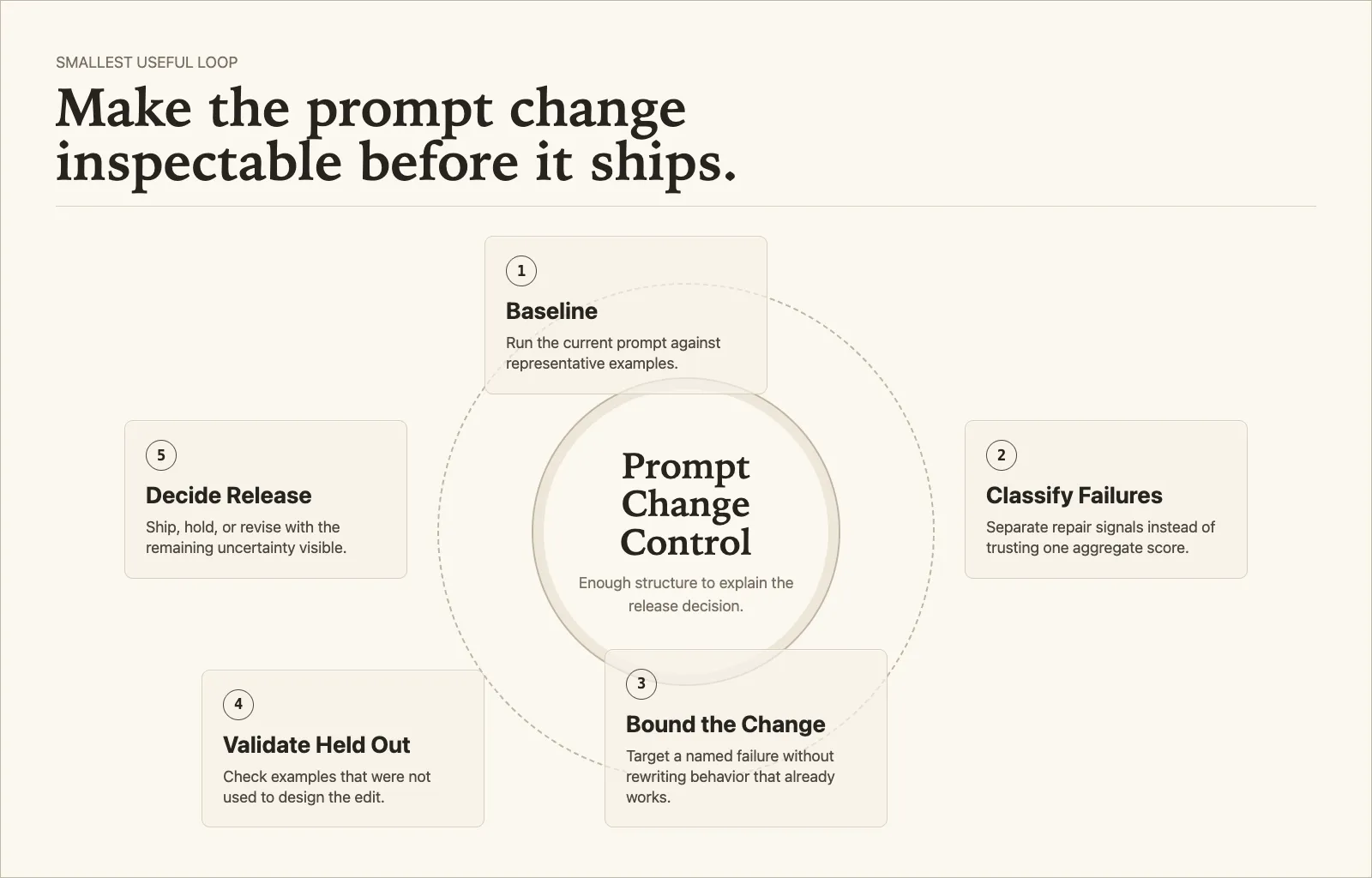
The minimum useful control loop makes prompt changes inspectable before they are promoted.
Promptimus as a Proof Point
Amazon Science’s May 2026 Promptimus article is useful because it shows this loop as a mechanism rather than a slogan. It should be treated as a bounded proof point, not as a promise that automation can make any prompt production-ready.
Promptimus starts with a target inference model, an existing prompt template, a small JSONL sample set split into development data for iteration and test data for checking the result, and a user-defined metric. It runs the original prompt to establish a baseline, breaks the metric into checkpoints so failures become diagnosable, and uses those checkpoints to guide repair. From there, it proposes strategies or edits, evaluates candidates on the development set, and iterates.
The business-relevant detail is edit mode. For longer prompts, Promptimus can make structured find-and-replace edits rather than regenerating the entire prompt. That matters when the prompt already contains carefully arranged rules, schemas, examples, or domain taxonomies.
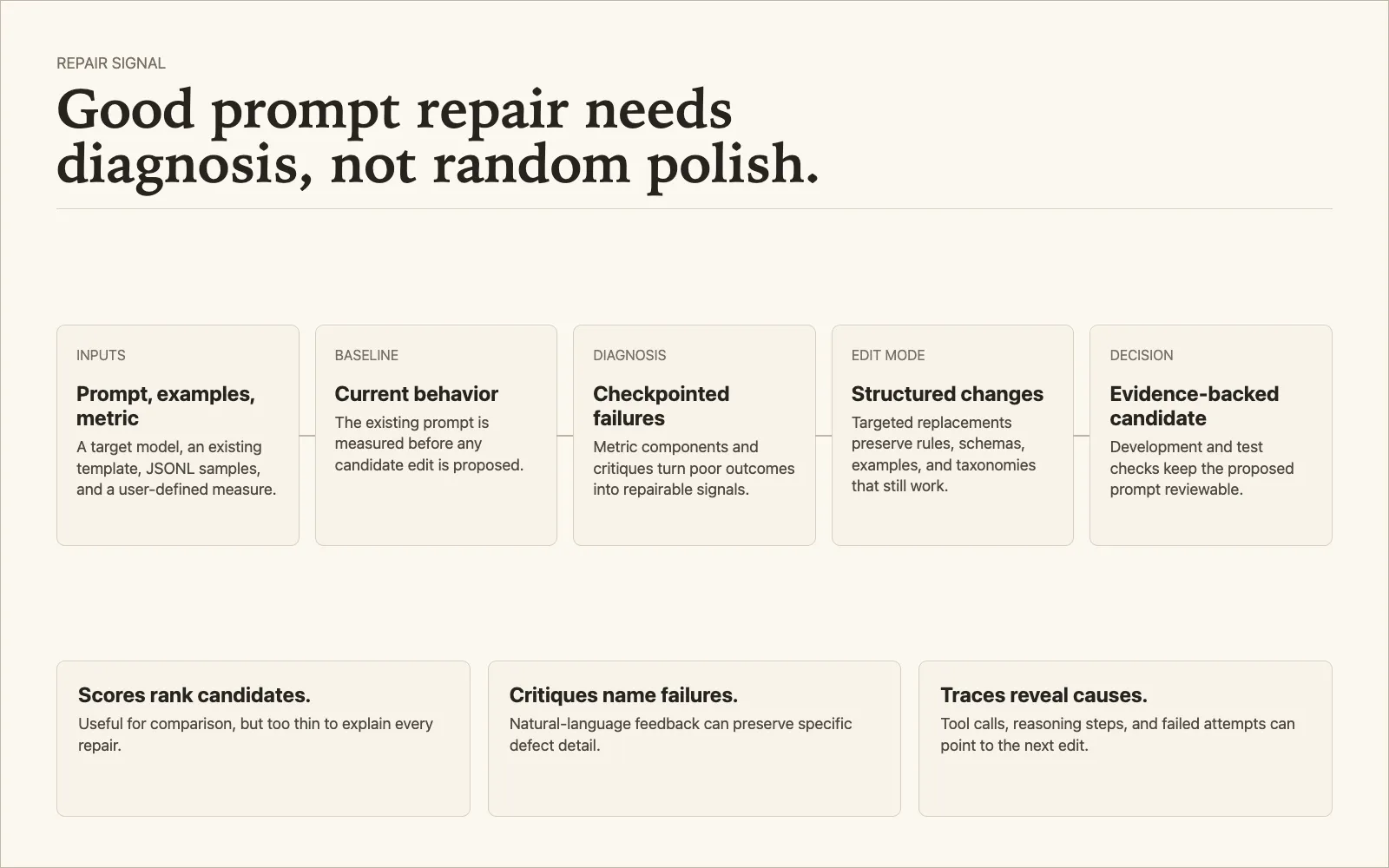
The durable lesson from Promptimus is not automatic perfection. It is diagnosis-driven repair with evidence attached.
Amazon reports broad benchmark and enterprise-task improvements, but those results are not the main lesson. The durable lesson is that once prompts are already good, random prompt polish is a weak optimization strategy. The remaining gains often sit behind specific failures that need specific evidence.
Quality Signal Is More Than a Score
Prompt improvement needs evidence, but that evidence does not have to be only numeric. Work on prompt learning and the GEPA research paper point in the same direction: useful repair signal can come from natural-language critiques, recurring failure patterns, and traces of what happened during a run, not just from a final score.
That distinction matters because many application failures are easier to describe than to score. “The output used a deprecated category,” “the answer ignored the customer’s region,” and “the tool call used the wrong argument” are more actionable than a bare 0.6. GEPA, short for Genetic-Pareto, extends that idea to trajectories: records of reasoning steps, tool calls, tool outputs, failures, and attempted repairs that can all become evidence for a prompt update.
The safe takeaway is not that reflection-based optimization always wins. It is that a trace of what happened can contain repair information that a scalar reward, or single final score, throws away.
There are limits. Natural-language feedback is only useful when the evaluator can produce specific, reliable critiques. If the base model lacks the required knowledge or capability, prompt optimization will not supply it. If the sample set does not resemble production traffic, the optimized prompt may improve the test while missing the real workload. Prompt improvement is engineering, not magic.
Model Migration Reopens the Release Question
Model migration is where the change-control lens becomes hardest to avoid.
A prompt that worked under one model is partly adapted to that model’s instruction-following style, formatting habits, reasoning patterns, and tolerance for ambiguity. Moving the same prompt to a new model may improve many cases. It may also disturb assumptions that downstream systems rely on.
That does not make model upgrades unsafe by default. It means the upgrade is a recertification moment for prompt-dependent behavior. The question is not “Is the new model better?” The question is “Does the application still do what this prompt commits it to doing?”
Tools already reflect pieces of this pattern: evals for model-change evidence, prompt-management systems for drafts and versions, and prompt-flow tools for experiment-to-monitoring lifecycle. OpenAI’s Evals platform and Microsoft’s classic Prompt Flow both have deprecation or retirement caveats, so the point is not product adoption. For production AI systems, the point is that prompt work is being pulled into application release machinery.
The migration decision should compare behavior, not vibes: old prompt and old model, old prompt and new model, proposed prompt edit and new model. Without that comparison, the decision is being made in the dark.
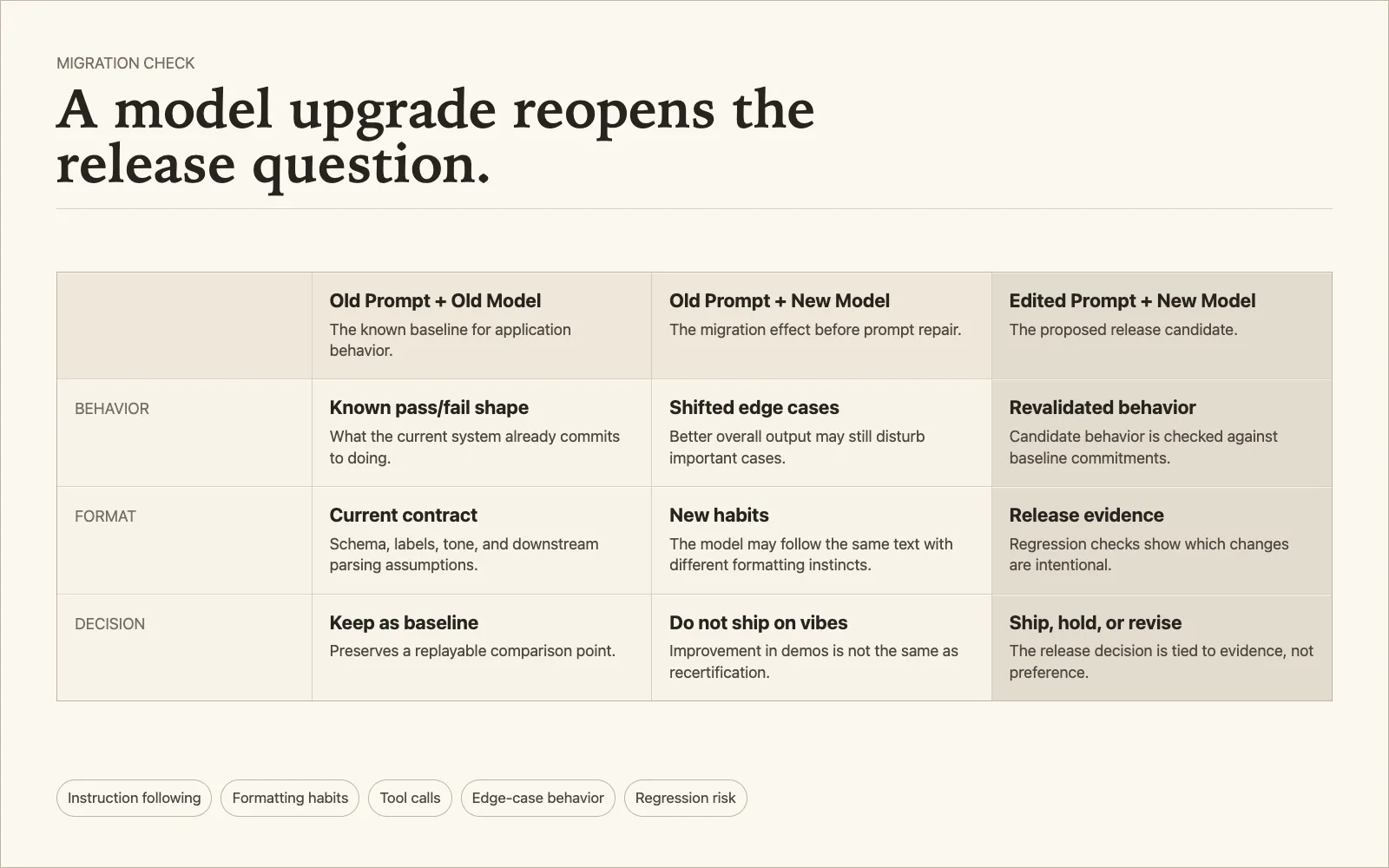
A model upgrade should compare behavior across prompt and model versions, not rely on whether the new output feels better.
The Buying or Building Test
The right buying or building question is not “Does this tool optimize prompts?” It is “Can this system support change control for prompt-dependent behavior?”
A useful system should preserve the current prompt as a baseline, run the same examples against old and new candidates, separate development examples from held-out validation examples, show failure categories rather than only an aggregate score, preserve the proposed change as a reviewable diff, compare prompt and model versions, identify regressions in behavior that already worked, and connect the accepted prompt version to the application that invokes it.
If the answer is no, the team may still use the tool, but it should not confuse prompt optimization with prompt governance. A tool that generates candidate prompts is one part of the loop. A tool that stores prompt versions is one part of the loop. An eval harness is one part of the loop. None of them, by itself, decides whether a changed application should ship.
For small teams, the system can be modest: a versioned prompt, a representative example set, a scoring script or rubric, a failure log, a diff of the proposed change, and a release note explaining the decision. Larger systems may need more explicit ownership, review, monitoring, and deployment controls. The maturity level can vary. The shape of the control should not.
The decisive test is whether a prompt change can be replayed and explained. If customer-impacting behavior changed, can the team say which prompt version changed it, why that change was made, what evidence supported it, and what validation was performed before release? If not, the system is still operating on prompt craft, not change control.
Closing Judgment
The future of prompt improvement is not better phrasing alone. It is better evidence around application behavior.
Better models may reduce some prompt burden. Better prompt writers will still matter. Automated prompt optimizers can sometimes find repairs that manual review might miss. But once prompts encode business rules, output contracts, operational constraints, or domain judgment, improvement has to move through a release discipline.
A prompt is still text. In production, it is also a control surface. Treating it that way is the difference between editing words and changing an application on purpose.
Sources
- Amazon Science: “Promptimus: Improving already good LLM prompts with zero manual engineering”
- Comet: “Prompt Learning: Using Natural Language to Optimize LLM Systems”
- GEPA: Reflective Prompt Evolution Can Outperform Reinforcement Learning
- OpenAI API docs: Working with evals
- OpenAI API docs: Evaluation best practices
- AWS Bedrock docs: Prompt management
- Microsoft Learn: Prompt flow in Microsoft Foundry portal (classic)